Supper, Then Stars: An Unfussy Night Under the Brecon Sky
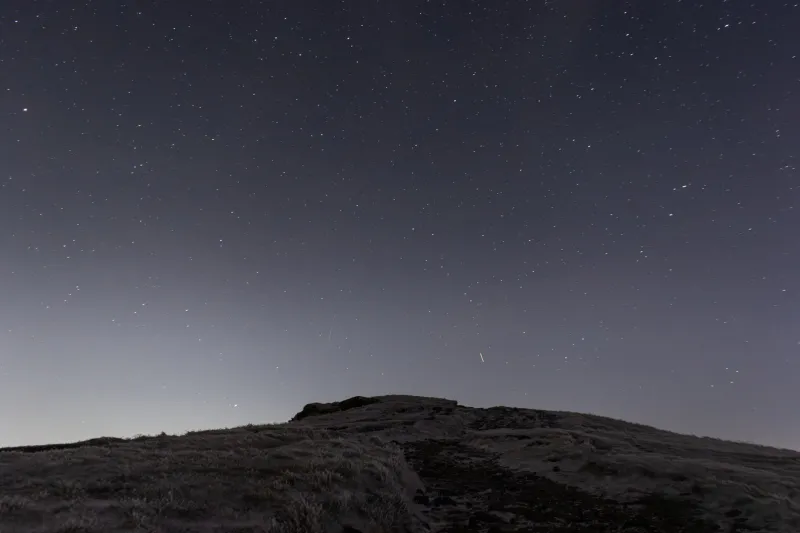
Dark comes early after supper at this time of year. In Brecon, that is not a reason to draw the curtains; it is a reason to put a coat on. The Bannau Brycheiniog is one of the better places in Britain to look up, and the good news for anyone who has never owned a telescope is that the sky does most of the work.
This is not a night-sky masterclass. It is a slow-travel plan: eat, wrap up, walk a few minutes beyond the last street lamp, stand still, and let your eyes settle. A flask helps. A red torch helps more than you’d think. A warm room to come back to makes the whole thing feel less like an expedition and more like an evening out.
Start at the last street lamp
You do not need to drive to the darkest point on a map. From Danyfan Brecon, the easiest route is simply away from the town’s glow: follow a quiet lane, a footpath or the edge of a field until the streetlights are behind you and the sky above you opens up. If you have a car, a short run to an open pull-in or a lakeside verge can be lovely, but keep it simple and legal. Don’t block gates, don’t wander into a field you don’t know, and don’t make the return journey the hardest part of the night.
Tell someone where you’re going, even if it’s only across the road. Take a phone, but keep it in your pocket. Take a small torch for the walk back, and keep it low. The aim is not to find the perfect dark-sky site; it is to find a patch of dark that is easy to leave. If cloud rolls in, no shame in turning round. The kettle is still there.
Pack light, pack warm
The kit list is short. A flask of tea, coffee or soup. A red torch — or a normal torch covered with red cellophane and an elastic band — so you can check the path without scrubbing out your night vision. Warm layers, a hat, gloves, waterproof boots. A sit mat or a spare blanket if you plan to linger. Binoculars are a nice bonus, not a requirement. Leave the telescope at home.
You also don’t need an app. In fact, the evening works better without one. Phone screens are bright enough to undo twenty minutes of dark adaptation in a second. If you like a bit of guidance, print a simple star chart before you go, or take a pocket guide. Otherwise, trust your eyes and let the sky come to you.
Give your eyes twenty minutes
Find your spot, turn off the white torch, and stand still. It takes roughly twenty minutes for your eyes to adjust properly to the dark. At first you may see only a few stars. Then more appear. Then a faint band, perhaps, or a cluster you missed. This is the quiet bit. It is also the point.
Look slightly to the side of faint objects rather than straight at them; your peripheral vision is better in low light. Let your gaze drift. If the moon is up, don’t fight it. A bright moon washes out the faint stuff, but it also gives you shadows, silver edges and a very easy thing to look at.
Three easy things to find
You don’t need to name everything. Start with three.
Look east later in the evening for Orion. The three stars in a row are the belt, and they are hard to mistake once you’ve spotted them. Above and to the right of Orion, a fuzzy little patch is the Pleiades cluster — better with the corner of your eye than head-on. Over in the north, Cassiopeia’s stretched W is a good signpost for the darker part of the sky.
If you see a bright point that doesn’t twinkle much, it may be a planet. You don’t need to know which one. Stand there for a minute and watch. That is astronomy enough for most evenings.
The walk back is part of it
The cold eventually wins. That is fine. The walk back is short, and the last street lamp becomes a friendly thing rather than a nuisance. Boots off, coat on the hook, kettle on. The quiet room feels quieter because you’ve been out in the dark.
That is the small pleasure of a Brecon stargazing night: not expertise, not equipment, just a flask, a red torch and a bit of sky. The dark doesn’t ask you to be an expert. It just asks you to stand still for a while — and then lets you go back indoors.